|
SCR-536/BC 611
is a hand held radio in the 80-m-Band. Its appearance is well-known
to everyone, who saw one of the many films on D-Day. In the end of WW II it
played an important role in shortrange connection.
It was designed to work together with the portable/mobile Radio BC-1306.
The distances are amazing that can be still be covered
today despite small performance and an antenna with very small efficiency.
There are no more heating or plate batteries, there are, however,
plans for transducers.
One channel (out of 50) can be chosen by replacing crystals and coils , stored in the box BX-49.
Realignment and fine tuning can only be made by maintenance personell.
The radio comes in versions A,B,C,D,E,and F. Versions A to E have the same schematics.
A "Bottom Cover Asembly" can be attached to Version F, thus providing the radio with a jack for
external headset and a jack for an external microphone.
The BC-611 can also be tuned with the help of "Tuning Equipment IE-37".
In this case one BC-611-chassis is inserted into a test case "CH-312" , the second BC-611
remains in its original housing.
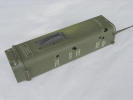 |
Test Case CH-312
|
Close relationship BC-611 and BC-745:
"BC-611" and "BC-745" (Pogo-Stick) have almost the same schematics.
The resonant circuits even are made of the same components.
The reason is that both radios were developed by the same producer: the company "GALVIN" .
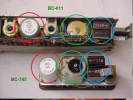 |
Resonant circles BC-611 / BC-745
|
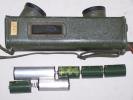 |
The PSU shown here is built by:
Pietro Noto. More infos:  HERE
HERE
|
It was replaced by PRC-6.
Special features:
The radio is switched on/off by un/collapsing the antenna,
There is no loudness knob,
There is no squelch.
BC-611 is a "Squad Radio", a small hand held unit for very local communications. The
collection shows all American Squad radios from their beginning (1941) to 1986. ==>
You may also read the article by Alan Tasker :
"U.S. Military Portable Radios"
The "bananas" in the collection
- Frequency range:
3,5... 3.6 MHz

Technical data :
- Channel spacing / number of channels:
- 40 kHz, 1 channel.
- Channels possible:
- 50
- Transmitting power
- 360 mW (the TM says 36 mW : a misprint)
- Frequency control
- Crystal
- Modulation:
- AM
- Sensitivity,
- 3 to 5 µV
- Tubes:
- 5
- Range:
- over land 1 mile
- over salt water 3 miles
- Antenna:
- collapsible rod antenna
- Batteries, Voltages, Consumption
- Filament battery BA-37, 2 x (parallel), 1.5V, Receiving: 250 mA, Transmitting: 300 mA
- Anode battery BA-38, 103.5V, Receiving: 11 mA, Transmitting: 35 mA
- Hand set
- built in
- Developed
- 1942 by "Galvin"
-
|
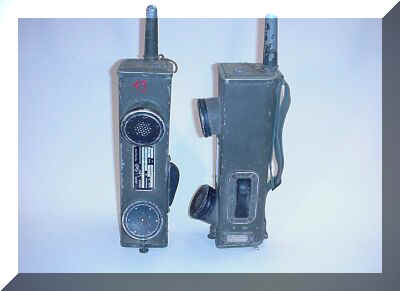
 WS-38
WS-38 Fox
Fox)
)
)